


Expanded capacity and industry-grade equipment now support faster, safer beverage product development
Canada’s beverage landscape is evolving fast — from non-alcoholic spirits and craft seltzers to kombucha, botanical teas, and innovative beers brewed from ancient grains. But while there’s no shortage of creativity, there is a bottleneck: scaling from a bench-top idea to a commercially viable product.
Niagara College’s Food and Beverage Innovation Centre (FBIC) has just taken a major step toward solving that challenge. The College has unveiled a significant expansion of its Beverage Pilot Plant at the Daniel J. Patterson Campus in Niagara-on-the-Lake — a state-of-the-art facility designed to help entrepreneurs develop, test, and refine new beverages before they hit the shelves.
“This expansion is about more than increasing square footage — it’s about elevating the level of service and support we can provide to the industry,” said Lyndon Ashton, Associate Director of FBIC. “We’re creating an environment that mirrors real-world production, so companies can innovate with confidence and bring high-quality products to market faster and more effectively.”
The renovation includes a completely reconfigured processing line featuring:
An automated canning system with rotary infeed
Rinse-and-code station
Nitrogen-dosed filler/seamer
Tunnel pasteurizer and dryers
A new 350-litre process tank, boosting batch volume from 200 to 600 litres — translating to roughly 500 to 1,600 cans per run.
This scale matters because it directly addresses the industry’s most notorious hurdle: the “0-to-100 case gap” — where a brand is too large to test on bench equipment, but too small to meet the minimum requirements of large co-manufacturers.
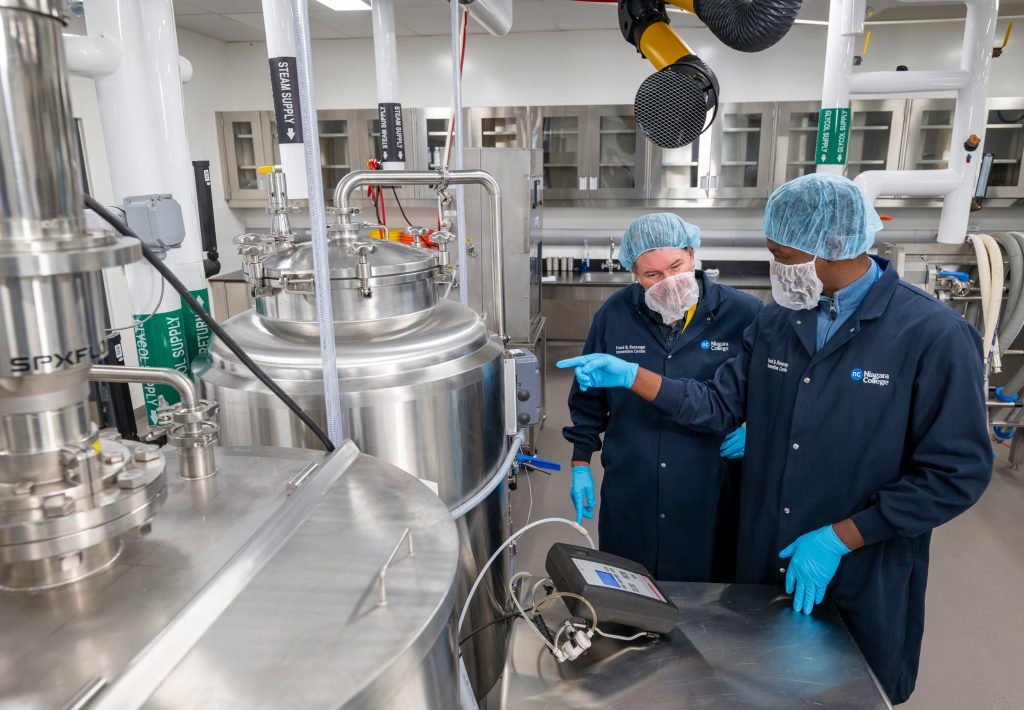
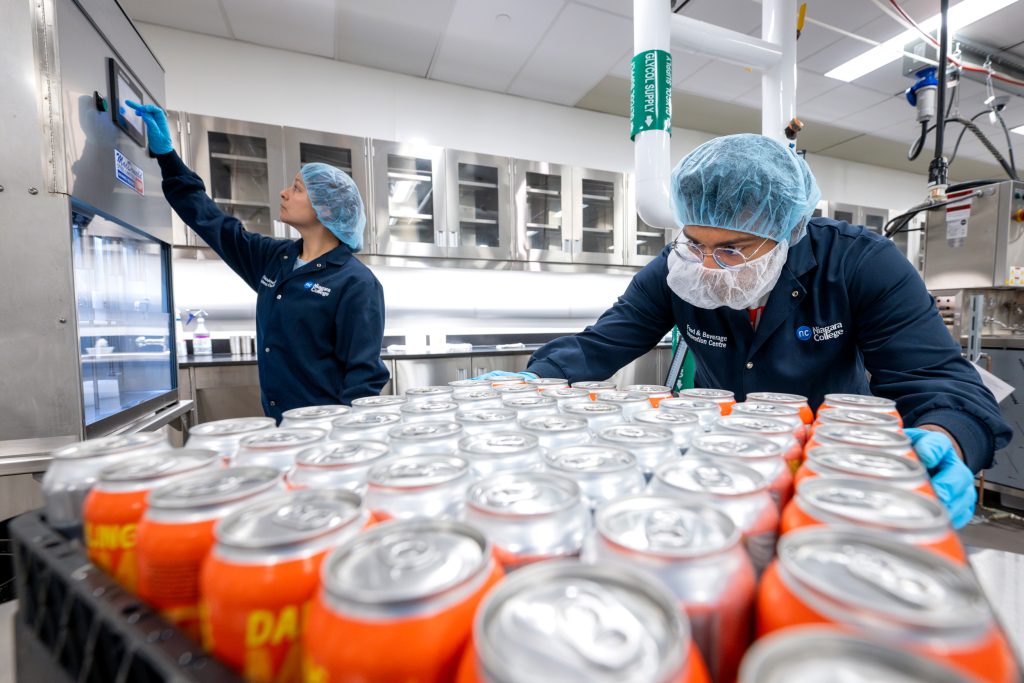
Technicians at Niagara College’s Food & Beverage Innovation Centre work in the newly renovated HACCP-certified Beverage Pilot Plant, dialling in CO₂ levels in the carbonation tanks as part of expanded production capacity and industry-standard equipment upgrades to accelerate beverage innovation.
The Pilot Plant is a HACCP-certified, CFIA-licensed facility, integrated into the Marotta Family Innovation Complex. In addition to processing equipment, the Centre houses labs for product development, formula and process optimization, shelf-life study, regulatory support, and sensory analysis.
FBIC’s work has already contributed to commercial success stories such as:
DistillX — Canada’s first zero-alcohol gin and tequila
Miski Ancestral — a gluten-free quinoa-based beer now listed at the LCBO
“Whether you’re a startup launching your first product or an established brand testing a new line, this upgraded space supports faster progression from bench to shelf,” added Ashton.
For Niagara College students, the expansion also means exposure to real industry workflows — strengthening the College’s longstanding reputation as one of Canada’s top research institutions.
“This renovation represents a strategic investment in the future of Canada’s beverage sector,” said Marc Nantel, PhD, Vice-President, Research, Innovation and Strategic Enterprises. “We’re empowering businesses and training the talent who will shape the industry moving forward.”
The Beverage Pilot Plant works with companies on a fee-for-service basis or through funded research collaborations. Interested SMEs can contact Business Development Manager David DiPietro at ddipietro@niagaracollege.ca.
– With files from Niagara College