


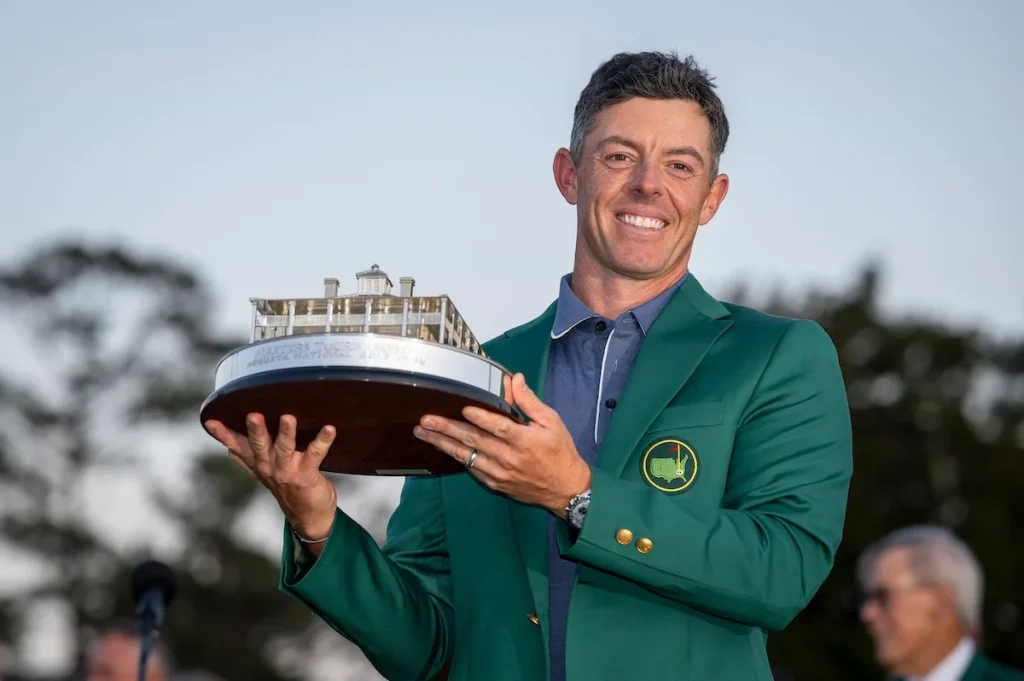
At Augusta National Golf Club’s most exclusive table, Rory McIlroy delivered a Champions Dinner as thoughtful in its wine pairings as it was in its storytelling
There are few traditions in sport that feel both mythic and oddly intimate at the same time. The Masters Champions Dinner—held each year as a precursor to the Master tournament itself, at Augusta, Georgia’s Augusta National Golf Club—is one of them.
On paper, it’s simple: past winners of the Masters gather for a private dinner hosted by the defending champion, who selects the menu. In reality, it offers a carefully staged glimpse into the personality of one of the most scrutinized athletes in the world—told through food, wine, and a series of choices that, intentionally or not, reveal quite a lot.
Read Also: Restaurants Canada Show: 6 trends shaping the future of drinks culture
This is Rory McIlroy’s turn to show off his tastes. And based on what he has put together, it is safe to say he did not just understand the assignment; he may have overdelivered.
As a golfer and a fan of the game, I watch the Masters every year. It tends to mark the unofficial start of the golf season here in the much cooler Toronto area spring environment, where I live. I cheered McIlroy on last year when all he needed was the Masters to complete his career grand slam, which is to win all four of the crown jewel major tournaments (those others being the US Open, the British Open, and the PGA Championship). And now, I have reason to cheer him on again, this time for his clear appreciation of wine and thoughtful food pairings. Let’s take a closer look at the menu layout he’s chosen, and what it all means.
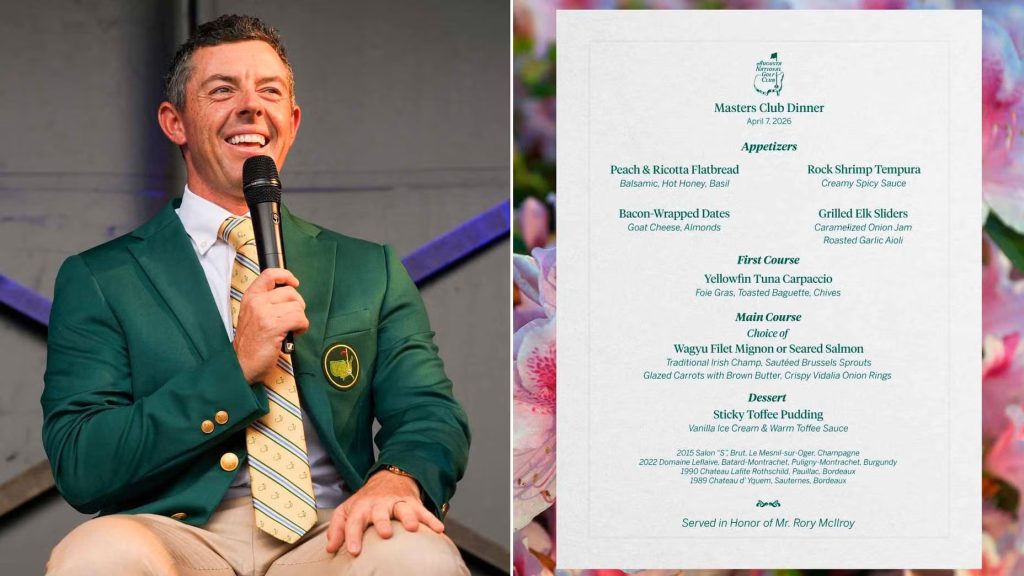
Rory McIlroy talks about his menu for the 2026 Masters Champions Dinner.
In a statement to the PGA Tour, McIlroy explained his thinking with a tone that feels equal parts thoughtful and disarmingly relaxed. “I wanted to try to bring a little bit of the local ingredients in,” he said of the Georgia peach and ricotta flatbread with hot honey—an opening bite that nods to place without trying too hard to prove it.
From there, the menu unfolds with an easy, deliberate rhythm. Rock shrimp tempura? “Sort of a crowd pleaser.” Bacon-wrapped dates? A family recipe. “My mum does these really, really nice dates stuffed with goat cheese, wrapped in bacon.” It is the kind of detail that resonates, not because it is extravagant, but because it is personal.
Even the elk, arguably the boldest move on the menu, is dialled back into sliders. “I didn’t want elk to be the main course because I didn’t know if everyone would like that,” McIlroy admitted.
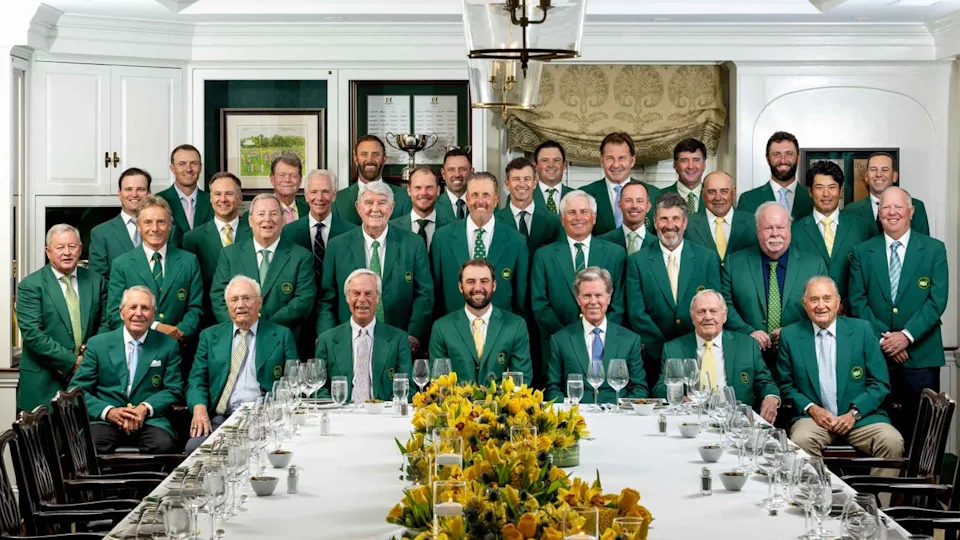
The official photo from 2025’s Masters Champions Dinner.
Then, just as the menu begins to settle into polished familiarity, it sharpens.
The yellowfin tuna carpaccio, inspired by New York’s Le Bernardin and chef Eric Ripert (currently one of his favourite restaurants), signals a deeper level of intention. “That’s a fun one that the club worked with me on,” McIlroy noted, referencing the effort to recreate the dish properly.
Still, as thoughtful as the food is, the wine is where the menu truly distinguishes itself.
Champions Dinner selections have historically leaned into nostalgia, indulgence, or personal comfort. McIlroy’s does all three.
“My favourite part of the menu is you obviously get access to the wonderful wine cellar at Augusta National,” he said.
Beginning with a 2015 Salon Brut Champagne is, frankly, a statement. Salon is rare, and quite revered.
The white that follows, a 2022 Domaine Leflaive Bâtard-Montrachet, adds another layer of clarity. “It’s the first-ever white wine that I actually liked,” McIlroy said. It is a charming admission, but also an illuminating one. Leflaive’s Bâtard-Montrachet is not an entry-level discovery; it is a benchmark. You do not arrive there by accident.
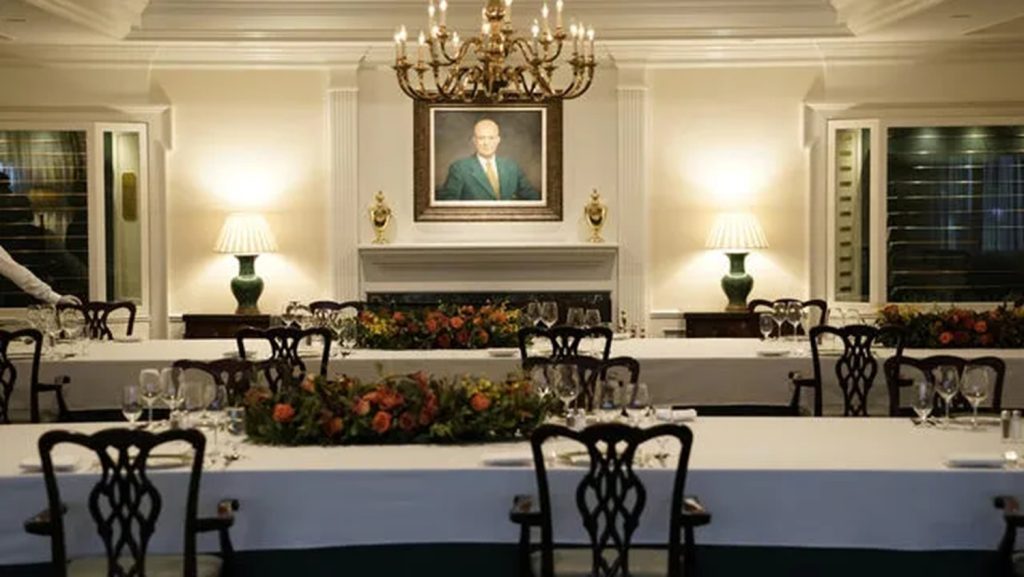
A peek inside the traditional dining room at the Augusta National Clubhouse.
The red wine is where everything comes into focus.
A 1990 Château Lafite Rothschild—“the wine that I drank the night that I won the Masters,” McIlroy shared. At this point, the dinner shifts from impressive to meaningful. It is no longer just about pairing wagyu with Bordeaux (though it does that beautifully), it is about anchoring the evening to the moment that made it possible.
And then, to close, a 1989 Château d’Yquem—his birth year. “Every great meal deserves to be finished off with Château d’Yquem,” he said, calling it “like liquid gold.” It is a fitting conclusion: personal, indulgent, and just a touch self-aware. Fittingly, he’s paired it with Sticky Toffee Pudding with Vanilla Ice Cream, which just so happens to be one of my favourite desserts.
What is most compelling about this menu is not simply how good it looks on paper. It is what it reveals.
The Champions Dinner has always been about more than food. It is a rare moment where some of the most competitive figures in sport step away from the spotlight and, for one evening, become hosts. Curators. Storytellers.
McIlroy’s interpretation lands squarely in that space. It is polished without being rigid, personal without being indulgent, and, perhaps most surprisingly, deeply fluent in wine.
“I wanted to be really intentional with the wines,” he said. “It’s something that I’m really into and passionate about… I’ve started to collect wine, probably over the past decade.”
Of course he has.
Because in 2026, it seems, it is no longer enough to win the Masters. You also need to quietly assemble one of the most dialled-in wine pairings the dinner has seen in years.
And maybe that is why we care so much; why every detail of this menu gets dissected, shared, and debated.
It is not just about what is on the plate or in the glass. It is about access. Personality. The rare opportunity to see icons of the game not as competitors, but as individuals with taste, memory, and a point of view.
In McIlroy’s case, a rather convincing one. Who knew?
– Carmelo Giardina is the principal editor for VineRoutes