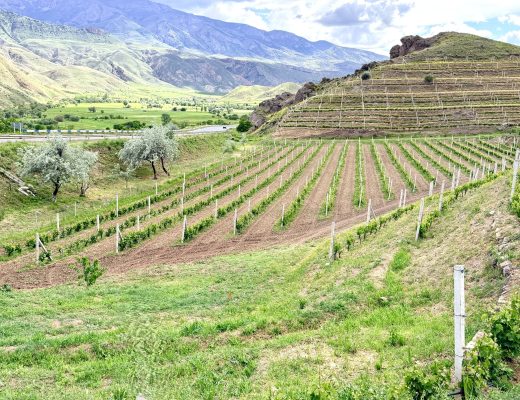




Shaped by Ann Sperling and Peter Gamble, Versado has become a living archive of Argentina’s vinous heritage
High in Argentina’s Luján de Cuyo, beneath the gleaming Andes, Ann Sperling and Peter Gamble have carved out a winemaking niche that marries the old world with the new, crafting wines rooted in a vineyard that proves “a century in the making” can be more than just a mere phrase.
Their project, Versado, is as much a love letter to Argentina’s signature grape as it is an homage to history. At its heart lies a vineyard planted in 1920—a humble three-hectare parcel of ancient malbec vines, own-rooted and still thriving more than a century later.
Read Also: Explore Argentina’s diverse, terroir-driven malbec wines
But Versado didn’t begin as a plan. It began as a curiosity; a spark ignited in the early 2000s when Sperling and Gamble— each with distinguished winemaking credentials in Canada— first discovered the majestic landscapes of Mendoza and saw an opportunity to expand their winemaking horizons.
“Mendoza is beautiful wine country,” assures Sperling. “The dry climate, the majestic snow-peaked mountains—we became captivated. In the end these features clinched it for us: the history of fine wine, the quality of the vineyards, the professionalism of both viticulturists and winemakers and the opportunity to do something completely different from our wine-lives in Canada.”
“And, importantly, we loved what we felt was the potential of malbec and the opportunity to do work with ancient, own-rooted vines,” adds Gamble. “A chance to do a second harvest every year, in a radically different climate especially, was appealing, in terms of advancing professional skills.”

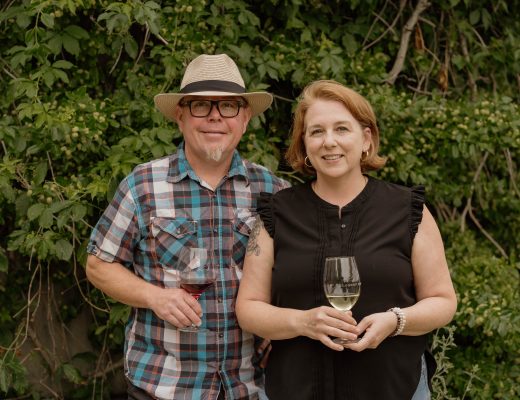
Ann Sperling and Peter Gamble.
The couple – husband and wife, and a dynamic force behind several award-winning Niagara wine ventures, including, most recently, Lailey/Stonebridge and Dobbin Estate – had long envisioned expanding their wine journey beyond Canadian borders. Gamble, ever the explorer, took it upon himself to scout possibilities, evaluating over 230 properties across the region. What they were seeking wasn’t merely land—it was history, potential, and a sense of authenticity.
“An ancient vineyard was our preference from the outset,” says Gamble. “But it was difficult to find one that met our standards, especially in the ‘sweet spot’ we identified for great old-vine malbec.”
They found their answer in Perdriel, a sub-region known for its deep wine heritage and proximity to the cooling currents of the old Mendoza River valley. The site, damaged by hailstorms in 2006 and 2007, was overlooked by many—a fixer-upper that most wouldn’t bother with. But for Sperling and Gamble, it was a diamond in the rough.
“The vineyard was planted in 1920 and contained an excellent massal selection of malbec vines on their own roots,” Sperling says. (Massal is a French wine growing term for the practice of replanting new vineyards with cuttings from exceptional old vines from the same (or nearby) property.) “It presented amazing potential.”
A different kind of malbec
Stewardship of these old vines is not a passive task. It’s an ongoing commitment to preservation, sustainability, and understanding. Sperling and Gamble see themselves not merely as winemakers, but as caretakers of a viticultural legacy.
“These vines represent the patrimony of malbec from France to Argentina,” Sperling says. “After 105 years, the vineyard is not only resilient but is producing the best quality wines in its history.”

Versado’s century-old vines may hold a key to the future.
The idea of un-grafted vines—vines grown on their original rootstock, without intervention of foreign root systems—is central to Versado’s philosophy. “We were skeptical at first,” Gamble admits. “But malbec vines grown on their own roots offer the finest and, one presumes, most authentic interpretations of malbec.”
Gamble goes on to explain that while most of the world uses grafted vines to mitigate issues like phylloxera, Argentina’s sandy soils allow many vineyards to remain phylloxera-free. The result is a lineage of vines that maintain original DNA—un-cloned, unadulterated, and expressive of their place.
Through all this, it’s evident that Versado’s wines stand in contrast to the modern, heavily stylized malbecs that flooded the market during the Parker-Rolland era of winemaking. Gamble is candid in his critique: “Sur-maturity, over-oaking, high alcohols, low acids, and reverse osmosis robbed malbec of its individuality and distinction.”
Instead, Sperling and Gamble strive for elegance. With yields averaging less than 1.5 tonnes per acre, they craft wines that are ethereal, pinot-like in their finesse, and deeply expressive of terroir. Wild fermentations, minimal intervention, long barrel aging in neutral oak, and use of whole clusters are all methods they employ to retain that authenticity.

An image from the 2013 harvest. (c) Versado.
They were initially surprised, however, by the local reluctance to embrace wild fermentations. “When we arrived nearly 20 years ago, it was generally held that the pHs were too dangerously high to take any chances,” Gamble recalls. “We did it anyway.”
“Of course, tasting a plethora of the regional wines and listening to the experiences of the finest local winemakers added layers of depth to the process,” adds Gamble.
The value of time
With old vines comes resilience. As climate variability becomes a growing concern across the global wine industry, Versado’s century-old vines may hold a key to the future.
“With increasing age, they seem to become more tolerant of variations in sun, winds, precipitation and climate,” says Gamble. “Enabled by more extensive root structure and low, steady productivity, a discernible nobility of growth emerges.”
Sperling adds that the process of “layering” allows new plants to grow from existing vines, retaining the genetic memory of the past while remaining adaptive. This form of vegetative propagation has helped the vineyard preserve its genetic richness, offering researchers a window into the evolutionary potential of malbec.
And on that note, it’s important to mention that Versado is currently participating in a major study led by INTA, Argentina’s national agricultural technology institute, to examine the genetic diversity of old malbec vines in Luján de Cuyo.
“We are in the rarest category at over 100 years,” says Sperling. “They want to study our massal selection and see how it has evolved in the past 105 years.”

Tasting and talking Versado, with Peter Gamble and Ann Sperling, in Niagara.
It’s understood that this work could have profound implications. The vineyard’s genetic material, dating back to a time of great diversity before Argentina’s mass rip-out periods, may hold clues to disease resistance, climate adaptation, and future clonal development.
“Having some of the oldest malbec DNA on the planet puts us in a unique position,” Sperling notes. “This type of research may reveal something completely unexpected.”
A focus on identity
Though Versado is located thousands of kilometers from their home in Niagara, Sperling and Gamble’s northern roots have informed their work in profound ways.
“The greatest skill we’ve developed over the years is an ability to analyze a vineyard site and project its potential,” says Sperling. Their combined experience—Sperling as one of Canada’s most respected winemakers, and Gamble as a consultant and industry leader—prepared them well for this foreign yet fertile frontier. “Working in a southern hemisphere wine region presented the ultimate challenge to our instincts,” she says.
“Eventually it becomes crystal clear,” Gamble adds, referring to the unique growing conditions of Mendoza. “And a greater comprehension of practices in both regions is the result.”
“The greatest skill we’ve developed over the years is an ability to analyze a vineyard site and project its potential.” – Ann Sperling
As Versado enters its second decade, the focus has become ever more precise. Sperling and Gamble are phasing out their lowest price tier, opting to crop and manage the entire vineyard at the highest level.
“We are focusing our message on Old Vines,” Sperling says. “Managing the vineyard for best quality and expression of place while respecting the old vine heritage and doing the best we can for the planet.”
Sperling further addresses the fact that “Our goal was to gently bring vitality to the soil, and to bring forward the character of the unique vineyard site through regenerative soil management, including using a horse to minimally work the soil.”
Their journey, in essence, is about balance: between old and new, intervention and restraint, Canadian pragmatism and Argentine romance. It’s about finding identity in the vine and allowing that identity to speak clearly in the glass.
“Same old, same old,” Gamble quips, when asked about future plans.
But there’s nothing ordinary about Versado. In a world increasingly fascinated with the new, Sperling and Gamble are proving that sometimes, the way forward begins with looking back—to a vineyard that has endured for more than 100 years, and to the timeless story it continues to tell.
Versado’s century-old vines are telling its story beautifully through these wines, some of which were tasted with Ann and Peter:
 Versado 2019 ‘Old Vines’ Malbec
Refined and expressive, this is a wine that speaks quietly but with conviction. Crafted from vines planted in 1920, a massal selection of own-rooted malbec from an era when Argentine winemaking was at its pinnacle, this wine is an indication of quality and longevity. Aromas of ripe black fruit, violets, and a touch of coconut lead to a silky, medium-weight palate with fine tannins and refreshing brightness. The oak is beautifully integrated, supporting a medium to long finish. (Note: This wine ranked #4 in VineRoutes’ Most Outstanding Red Wines of the Year for 2024.)
 Versado 2019 ‘Centenary Vines’ Malbec
An elegant expression of old-vine malbec, this delivers both finesse and depth. The nose opens with lifted notes of tomato leaf, fresh herbs, and subtle floral tones, followed by a delicate sweetness reminiscent of sun-ripened tomato. On the palate, the wine is structured and finely textured, with chalky tannins providing a firm yet graceful backbone. There’s a lovely minerality throughout—like river rock after rain—that leads into a clean, persistent finish. Release of this wine is scheduled for October of this year.
 Versado 2013 ‘Reserva’ Malbec
(Tasted during a visit with Ann and Peter in fall of 2024) I was struck by this wine. A wine that transports you to its origins, reflective of the passion and precision of Ann Sperling and Peter Gamble. Aromas of coffee bean, crushed gravel, and earth lead to flavours of tomato leaf and concentrated minerality, all delivered with velvety softness. The 2013 vintage is a testament to Versado’s small-batch dedication to authenticity and terroir-driven expression. Listed as one of my top 5 Most Memorable Wines tasted in 2024.
Versado 2014 ‘Reserva’ Malbec
A wonderfully expressive wine that showcases both varietal character and vintage precision. The nose opens with gravelly minerality and green-tinged aromatics—think tomato leaf, crushed herbs, and a touch of tobacco. There’s an earthy depth that suggests age and intention. On the palate, the wine follows through with remarkable clarity. Herbaceous and savoury notes unfold over a plush, soft mouthfeel that’s both structured and graceful. The fruit is restrained but focused, allowing the wine’s texture and complexity to take centre stage. The finish is long and superbly integrated, making it a natural partner for lamb or richly marbled meats.
Ann Sperling describes this as a turning point for Versado, saying “This is our favourite vintage since 2009. We made a change to our winemaking protocol and included a small percentage (15%) of whole clusters in the fermentation.”
Versado 2020 ‘Reserva’ Malbec – Certified Organic
Bold and beautifully composed, the 2020 Reserva is a richly layered expression of old-vine malbec. Powerful in structure yet impeccably balanced, this full-bodied wine delivers generous depth and flavour. Juicy dark fruit meets savoury undertones, all wrapped in a frame that speaks to its aging potential. Aged for 24 months in French oak, the wine has gained elegance and nuance, with tannins that are firm but well-integrated. While already showing impressive clarity and character, a lengthy decant is recommended to fully unlock its complexity. This is a wine built to evolve over decades—ideal alongside fatty meats or robust dishes that match its intensity. Release of this wine is scheduled for December of this year.
– Carmelo Giardina is the principal editor of VineRoutes