


From Reims to Épernay, uncover the stories, flavours, and places that make this region a pilgrimage for wine lovers
As a food and wine lover, I’ve always believed that some trips are taken with your palate, and others with your heart. Champagne, as it turns out, is both. Sure, it’s a wine region — and a UNESCO world heritage site with stunning vineyards, limestone cellars, and the world’s most famous sparkling wine — but it’s also a living museum of French history. Here, kings were crowned, wars were survived underground, and it’s a place where a monk named Dom Pierre Pérignon quietly worked before marketing turned him into a legend.
Somewhere between the coronation site and the cellars, you’ll inevitably find yourself at a table — hopefully starting with a dozen briny oysters — understanding that in Champagne, food and wine aren’t just paired; they’re bound together by history, geography, and culture.
Read Also: A wine lover’s escape: Why South Africa answers the call
This itinerary is not a checklist trip. It’s not about racing from one Champagne house to the next with flute in hand, though that’s fun! This is a modern-day pilgrimage. A slow, deliberate journey through a region where every sip tastes different when you understand the ground beneath your feet, and every bite — from pâté en croûte to a delicate macaron — tells a story just as compelling as the wine itself.
Day 1: From coronation to creation — the spirit of Champagne
Cathédrale Notre-Dame de Reims is where your journey should begin — one of the most important monuments in French history and the city that gave France its kings and Champagne its soul. It’s where Clovis I, the first king to unite the Frankish tribes, was baptized in the year 496 and marked the beginning of Catholic France. This elevated Reims to a sacred city and where power was crowned and blessed, coronating Louis the Pious in the 9th century to Charles X in 1825. The cathedral itself still radiates that authority. Stand in front of it for even a minute and you’ll feel it — the height, the history, the holiness of the place, even if you are not religious.
Once inside, take your time and absorb the vaulted ceilings to the stained-glass windows, where the significance of winemaking is proudly displaced–with paintings of wine grapes, harvest, and the winemaking process.
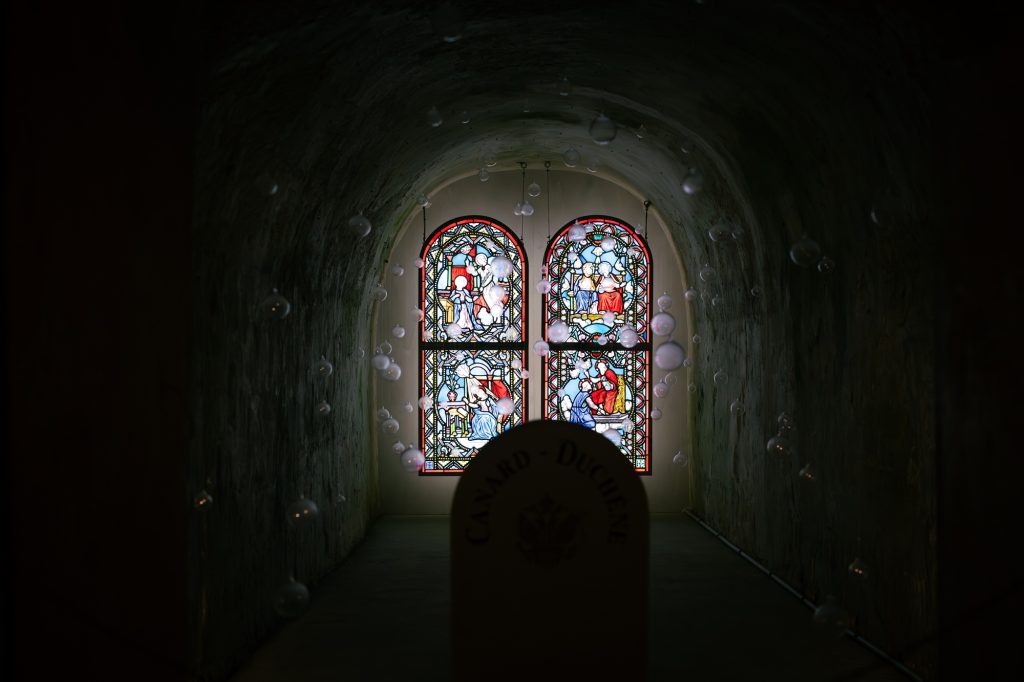
Inside the Cathédral Notre-Dame de Riems.
As you exit, don’t forget to admire the Smiling Angel, one of the cathedral’s most beloved sculptures. During World War I, her head was blown off by a shell, and her image became a symbol of loss across France. But like Champagne itself, she was restored. Today, her gentle smile is a quiet triumph — an emblem of resilience and grace.
By the time you step out of the church, your stomach will remind you that pilgrimages — spiritual or otherwise — run better on fuel. Luckily, in Champagne, “fuel” often comes in a flute.
Just fifteen minutes from Reims, Château de Sacy waits for you. It’s part boutique hotel, part fine-dining haven, and inside, velvet chairs and crystal chandeliers set the mood. I recommend sitting outside on the terrace, right next to neat rows of vines. Order a glass of blanc de blancs and wash it down with their delicious seabass fillet.
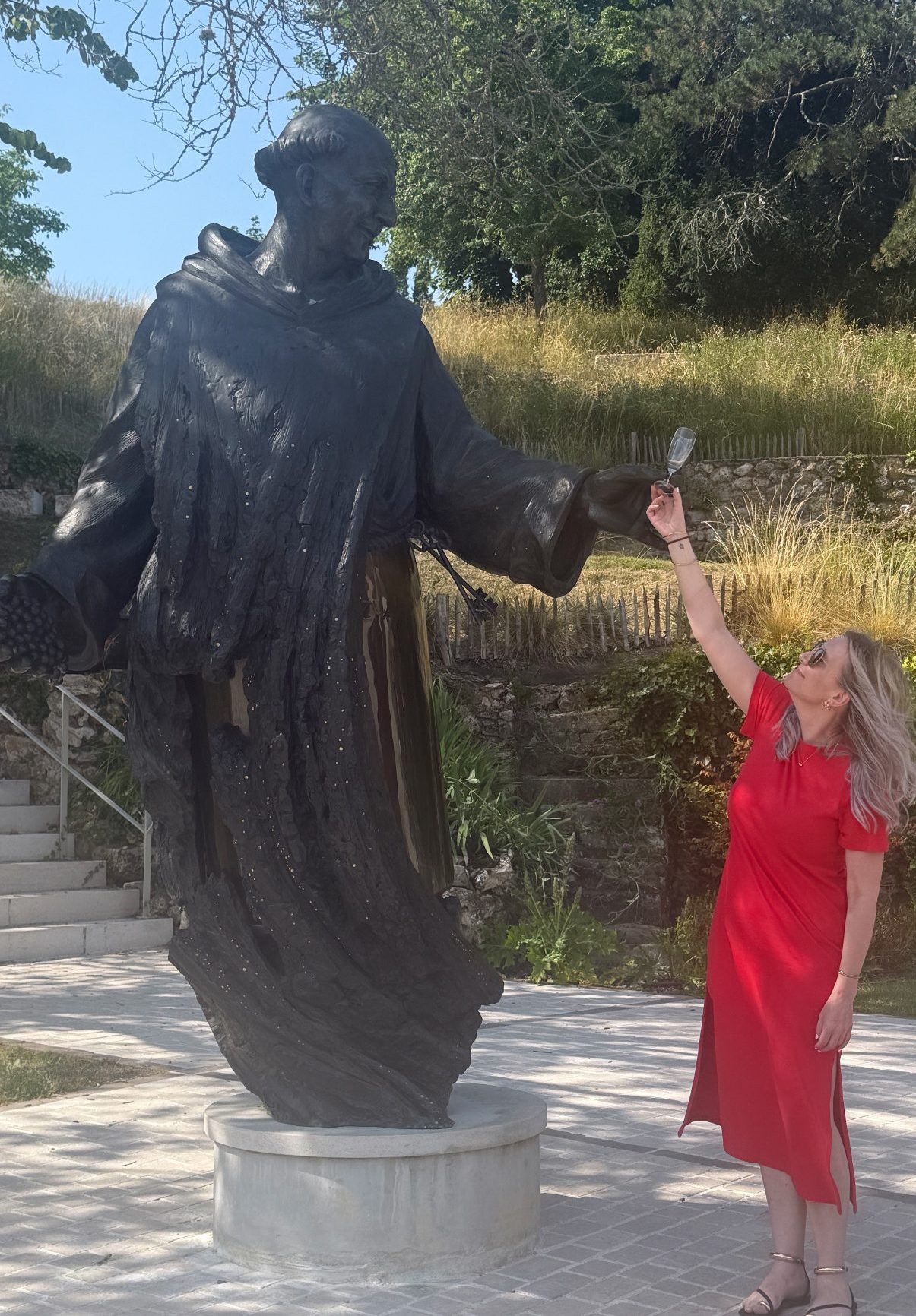
Statue of Dom Pierre Pérignon. (Mandi Robertson)
After lunch, make your way to the vineyard-laced slopes of Hautvillers. Here sits the Abbey of Saint-Pierre, now a modest parish church, but once the Benedictine monastery where Dom Pierre Pérignon served as cellar master for more than 40 years — and where he is buried.
In the choir, near the altar, lies his simple gravestone. No ornate marble or golden halo — just his name and dates. Standing there strips away the legend and leaves the man: a meticulous monk who quietly transformed winemaking in Champagne.
Contrary to the romantic story, Dom Pérignon did not “invent” sparkling wine. What he did was far more influential: he refined vineyard management, insisting on early morning harvests to preserve freshness and careful pruning to improve concentration. He pioneered gentle pressing to avoid bitterness, and perfected assemblage — blending grapes from different plots to achieve balance and harmony. The methods he developed became the very foundation that allowed Champagne to be made safely and consistently once sparkling styles became fashionable.
The Dom Pérignon we drink today is, of course, a luxury brand that came centuries later. Standing in Hautvillers, it’s easy to see the difference: the man was a perfectionist servant of his abbey, not a marketer. And yet, without him, the wine world’s most famous bubbles might never have had their chance to shine. A short stroll away, a bronze statue of Dom Pérignon waits, bottle in hand, for the inevitable selfie. Because even the most sacred pilgrimages deserve a little fun.
To finish your day, make sure to head to Clotaire restaurant which displays incredible French cuisine. It also holds a century-old wooden grape press — a silent, hulking reminder of how Champagne was once made.
Day 2: Luxury, legacy, and a vineyard lunch
Avenue de Champagne is only about a kilometer long in Èpernay, but this stretch is often called the “most expensive street in the world” — not because of the buildings above ground, though they are grand, but because of what lies beneath. Hidden underfoot are more than 100 kilometers of chalk cellars holding millions of bottles in perfect cool darkness.

Avenue de Champagne.
Walking down the avenue you’ll feel as though you’re passing through a living museum of Champagne’s great names: Moët & Chandon, Perrier-Jouët, Pol Roger. Their 19th-century mansions stand like chateaux in a lineup, each with manicured gardens, elaborate gates, and façades that seem to whisper their stories. At any moment, nip quickly inside a for a refreshing glass of Champagne – to keep your energy up of course. Though it’s easy to be dazzled by the luxury, keep in mind this street is also a working artery. The cellars below aren’t just for show — they’re where vintages are nurtured for years, sometimes decades, in the silence and constant 10°C of the chalk. Those same chalk walls, carved from ancient seabeds, have been the region’s secret weapon for centuries, insulating the wines from Champagne’s cold winters and warm summers.
As you stroll, you’ll see visitors heading to tastings, locals cycling past with baskets of bread, and delivery vans quietly slipping through the grandeur. The Avenue de Champagne is celebrating its 100th anniversary this year, but the spirit of the place feels timeless. And as much as you’ll want to linger, the vines are calling you.
After that walk, you’ve earned both a drink and a proper meal — and there’s no better place to satisfy both than at Champagne Vollereaux. This family-run Champagne house has been making wine for six generations, starting in 1805, when the first vines were planted in the village of Pierry, just south of Épernay. Today, the estate farms about 40 hectares, producing Champagnes that are elegant, expressive, and deeply tied to their terroir.

Picnic Lunch at Champagne Vollereaux.
Book ahead and you can enjoy one of the most charming wine experiences in the region: a picnic lunch right in the middle of the vineyard. They’ll set you up with a chilled bottle of Champagne, a basket of local specialties, and even a straw hat to keep the sun off while you sip. Glass in hand, feel free to wander between the rows, the quiet broken only by the wind in the leaves and the gentle fizz of bubbles in your glass.
And here, it’s impossible not to reflect on the past. It’s hard to imagine that the breathtaking landscape was once torn apart by two world wars. This region has known both destruction and rebirth, and maybe that’s why the wines here carry such a sense of celebration — they’re the product of a place that understands the value of peace.
Day 3: Beneath the earth, above the vines
If the pilgrimage begins in the light, it must eventually lead you underground. Beneath Reims and Épernay lies a hidden Champagne city — hundreds of kilometers of chalk cellars, first quarried by the Romans and later claimed by the region’s winemakers. The chalk cellars at Taittinger are especially moving.

Taittinger pupitres.
Beneath Saint-Nicaise Hill, the graceful remains of Gothic arches and vaulted ceilings remind you that these walls once held prayers long before they held Champagne. Graffiti lingers on the chalk — names, dates, love letters, prayers — etched by those who sought refuge here during two world wars. To stand there is to feel both the weight of fear and the defiance of hope.
Alongside that history, rows upon rows of bottles rest silently in riddling racks, each angled like a quiet bow to time. The space is at once a sanctuary, a storeroom, and a living museum — a keeper of memories as much as wine. You can imagine the monks who once laboured in devotion, the young soldiers who passed the hours carving into the stone, praying for peace, leaving behind a testament of resilience.
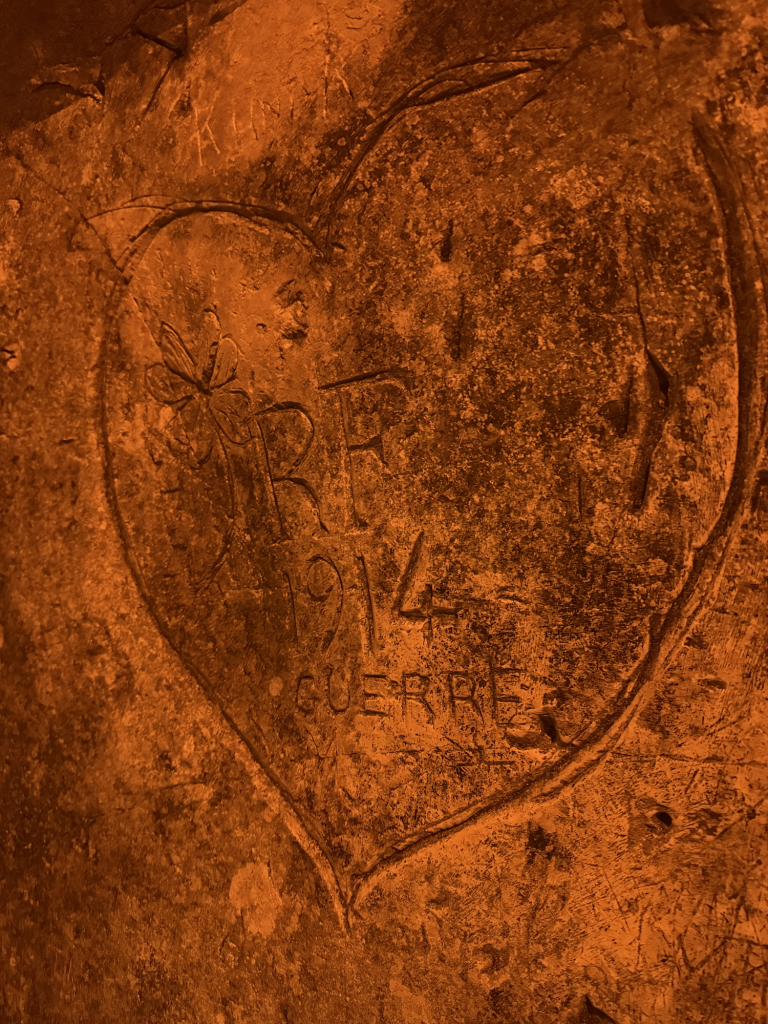
Drawings of a soldier WW1 – Caves at Taittinger.
When you finally emerge into daylight, blinking against the sun, your next sip of Champagne will taste different. Because now you understand that Champagne is also about endurance, patience, and rebirth. Insider tip? Make sure to have tissues on hand.
Now it’s essential to recharge properly—and, since you’re already at Taittinger, why not elevate your experience at their restaurant, Polychrome? This imaginative dining venue elevates the art of blending into your very own sensory adventure. Here, food and Champagne are paired with intention. Each dish centres around a single ingredient, complemented by creative condiments where you are invited to play with flavours while matching them to Taittinger’s full range of cuvées. Think of Polychrome as fine dining with a playful twist—where foodies can indulge in elegance while exploring flavours with curiosity.
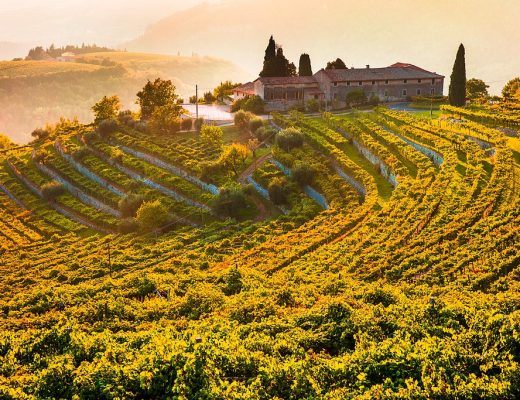
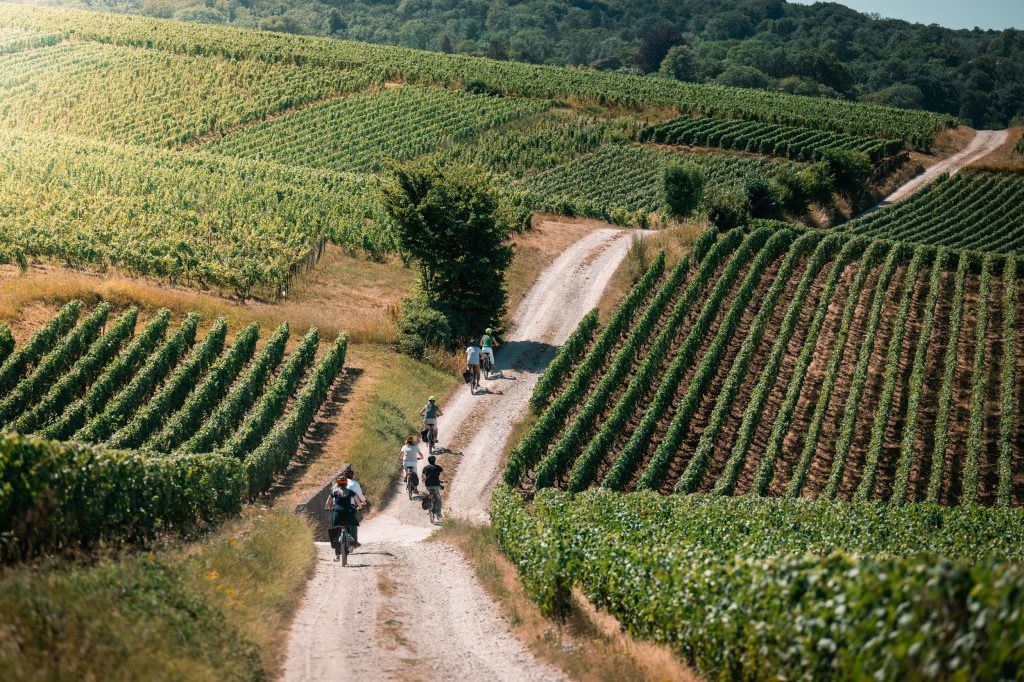
Now it’s time for you to step out into the very heart of Champagne and see the vines up close and personal. This is where the pilgrimage becomes physical by booking an e-bike tour at Canard-Duchêne. Glide through the rolling hillsides and admire row after row of green vines rising and falling like the sea. This is where you see the rhythm of Champagne life up close: the soils, the slopes, the centuries of history rooted in every plot.
Along the way, you’ll learn about the villages that grew up alongside the vines, the growers who have tended them for generations, and the battles fought to protect them. Don’t forget to pause mid-way through and take a sip of Champagne to rehydrate. When you return to the estate, order a bottle of Champagne and find an outdoor spot to settle in and admire the vines you just crossed. This is also the perfect moment to raise a glass—not just in celebration of Champagne’s landscape, history, and culture, but in recognition that Champagne is larger than us: a place where joy and resilience have always walked hand in hand.

Tasting Champagne at Canard-Duchêne.
And in this moment, it becomes clear why Champagne was inscribed as a UNESCO World Heritage site. The designation rests on three pillars: the historic houses and cellars, the chalk cellars, and the hillsides where the vines unfurl. Together, they represent a cultural landscape found nowhere else on earth, shaped entirely by the production and distribution of Champagne. Make sure to also celebrate yourself – by taking part in this modern-day pilgrimage—you’ve touched all three. It’s come full circle.
To discover Champagne this way is to discover more than wine. It’s to celebrate the harmony of land and people, past and present. It’s a reminder that beauty endures, that history breathes, and that joy still rises—like Champagne itself.
 Mandi Robertson DipWSET is a wine journalist, educator, and the host of Unwined with Mandi on CJAD800, where she makes wine approachable, engaging and fun. She’s also the regular wine contributor on Global News Montreal and writes for publications including The Suburban, Panoram Italia, and The Vintner Project. Mandi blends storytelling, education and a touch of humour to connect people to the world of wine. When she’s not on air, she’s likely exploring vineyards around the world with her son in tow – proving wine and life are both better when shared.