

Does the term “Chinese food” conjure visions of deep-fried wontons, sweet-and-sour chicken, and egg rolls accompanied by little plastic packets of plum sauce, hot mustard, and soy sauce? If so, it’s time to acquaint yourself with “authentic” Chinese food.
Much like the notion of Italian food, French food, Spanish food, Mexican food, or any other X-country food, the idea that the cuisine of an entire – usually very diverse – country can be lumped into a single “style” is to ladle a big assumption into a very small bowl.
Read Also: The Oxley bridges fine dining and pub comfort in Toronto’s Yorkville
As a VineRoutes reader, you’re probably beyond thinking that “Italian wine” denotes a single style. Barolo has nothing to do with Chianti, which has nothing to do with Amarone, which has nothing to do with Rosso Piceno. Heck, even one Chianti often has nothing to do (more or less) with another. So, to think that a place like China, with a land mass spanning some 9.6 million square kilometers, 23 distinct provinces, and over 1.4 billion people, has a sort of “uni-food” that can be defined as “Chinese” goes pretty wide of the mark. Dishes developed in Sichuan differ substantially from those common in Guangdong, Guizhou or Hunan. Which is what makes discovering “real” Chinese cooking a bit of a gastronomic adventure. Hungry for a first-hand crash-course in the mysteries and delights of Chinese-food-as-it-really-is? Pay a visit to Toronto’s MIMI Chinese.
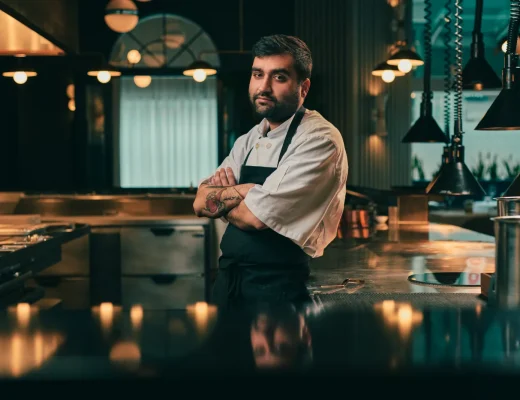
“The food landscape in China is so grand that it needs to be looked at more like a continent than a country. The differences in each regional palette are incredible,” confirms Chef David Schwartz (hint: he’s not Asian).

David Schwartz (Photo by: Daniel Neuhaus)
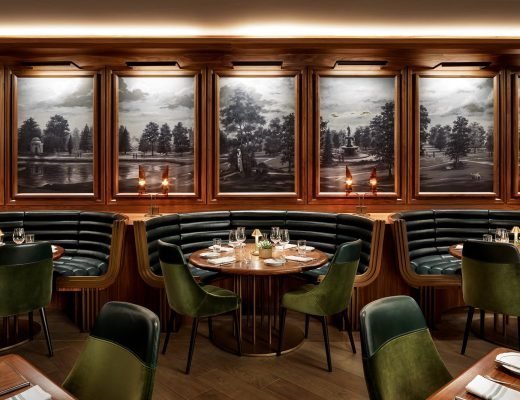
Perched on the northern fringe of the swish Yorkville ’nabe, MIMI Chinese is the physical manifestation of Schwartz’s obsession with Asian cuisine in general, and Chinese cuisine in particular.
“I am obsessed with Chinese food and cooking,” he enthuses. “I eat regional Chinese food several times a week at least. I think Chinese food is the most interesting food culture there is; the history, the technique, the textures, the colours, the fragrances. It’s all so exciting to me and we wanted to create restaurants where people could share in excitement.”
Those of you who follow the goings on in the Toronto restaurant scene likely know the backstory of how MIMI Chinese came to be. As it prepared to open, the pandemic stepped in with other plans. Schwartz and his team pivoted (and if I have to hear that word one more time…), opening Sunnys in Kensington Market – a sort of looser, louder, incantation of what MIMI Chinese would eventually become.
But all bad things must come to an end, so when COVID-19 finally shuffled out of town to sulk and likely mutate into an even nastier variant, MIMI Chinese was finally able to open.
While Schwartz strives to make the food at MIMI Chinese as authentic as possible, he and his five-member kitchen staff are not shy about sailing their culinary junk down less explored gastronomic tributaries. (Yes, that was admittedly a groan-worthy play on words; but there’s a modicum of cleverness to it, I think.)
“I was hopeful that people would be as excited about the concept as I was, but I never anticipated it to be as popular as it became.” – David Schwartz
“We have a few approaches to our menu,” Schwartz reveals. “Sometimes we will try to make the best version of a classic dish while keeping it very traditional. Sometimes we will cook in the spirit of a specific province and create a dish that might not exist in its exact form, but the flavour profiles are very reminiscent of what you might find in said province.”

MIMI Chinese (Photo by: Daniel Neuhaus)
You might find dishes like Supreme Fried Rice (with or without salmon roe), Shrimp Toast, and Char Siu Pork (brined and marinated meat is twice-roasted twice, and finished with local Ontario wildflower honey – an operation taking three days, or something a bit, well, more exotic, like a single, four-foot-long belt noodle doused in Sichuan chili oil, and topped with a mix of mushrooms and fresh cucumber that’s cut and plated table-side.
Ingredients for MIMI Chinese offerings are sourced both locally and imported directly from China. The menu varies somewhat based on ingredient availability, and Schwartz admits that he’s pretty stoked about the addition of a newly developed tasting menu.
MIMI Chinese developed an avid following from both local foodies and critics pretty much from the get-go (not surprising based on the popularity of Sunnys). But the restaurant’s success took even Schwartz a bit by surprise.
“Absolutely not,” he explained when asked if the accolades were expected. “I was hopeful that people would be as excited about the concept as I was, but I never anticipated it to be as popular as it became.”
I can personally attest to the fact that the dishes at MIMI Chinese are both creative and delicious. Having an interest in cooking is one thing but being tagged as “the most buzzed about young chef,” etc. suggests that Schwartz has become pretty good at it. He is, however, quick to point out that sure, he’s done what he can to hone his own skills, but he’s hardly done it alone.
“I like to regularly remind the people that I work with that I was never the guy winning MVP awards in anything I did, but I was often the one winning the most improved player award,” he admits. “I have learned a lot from my peers and have also taught myself a lot through reading, watching and lots of trial and error. I also do not attribute my successes to myself; we have a team of incredible people who gap fill for my many weaknesses.”
The wine program: an opportunity to try something new
Of course, a diverse and somewhat unusual food menu requires an equally creative beverage selection if the whole thing is going to work. Enter Wine Director Geoffrey Fleming. A trained somm, Fleming worked as a wine sales agent and wine educator before being called “back to the floor” by Schwartz last year. According to Fleming, pairing wine with the food offerings at MIMI Chinese can be a challenge.
“Regional Chinese cuisine is filled with unique flavours, he concedes. “While it can sometimes be challenging to find wines to compliment spicy or mala flavours, I prefer to look at it as a fun opportunity to try new food and wine combinations. European food has been paired with wine for millennia, and there are a lot of ‘rules’ about what should go together. With the flavours at MIMI Chinese, I feel like I have a blank slate to work with. It’s an exciting opportunity for me to try new things.”

MIMI Chinese also boasts a creative cocktail program, and a selection of over 20 baijiu (Chinese “white liquor”). (Photo by: Daniel Neuhaus)
Fleming does, however, feel that certain wine styles do have an edge when it comes to pairing with somewhat exotic flavours.
“I think the easy answer here is that I usually like to recommend cool climate or high-altitude whites,” he responds when asked ‘what works best?’ “Crisp Austrian gruner veltliner is great, as is Mosel riesling, and Italian whites from Alto Adige. When you’ve had a lot of spice or umami, these wines are always such palate pleasers. Recently though, I’ve been looking at the gastronomic similarities between our Chinese cuisine and Spanish flavours. They both incorporate spice, and spices, both use lots of seafood, rice and high-heat cooking. With that in mind I’ve been exploring some fun combinations of Asian food and Spanish wines. Truthfully though, there are dishes on our menu that can go well with just about any wine, if you’re willing to let go of some preconceptions.”
Read Also: Chef Q&A: DaNico’s Daniele Corona talks culinary fusion, innovation, and tradition
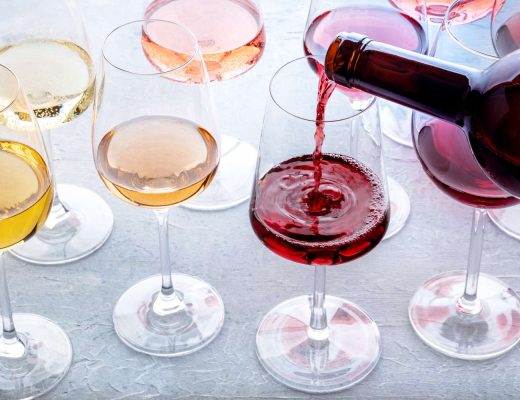
While some patrons are going to order red wine no matter what, Fleming has been encouraging his staff to recommend rosé as a “bridge” between red and white.
“Skin contact is a great ‘best of both worlds’ situation,” he points out. “You get brightness, freshness and acidity, but with a little bit of complexity and a longer finish. We’ve got some great skin-contact wines, and I’d love it if more people drank more of them year-round.”
While determining what wines are ultimately going to preform best with the MIMI Chinese menu, the “grunt work” of managing a wine program is not without its challenges as well. With approximately 120 labels on the list – all purchased through the LCBO consignment warehouse program – and limited space, the real juggling act becomes the “full bottles in; empty bottles out” equation. And if you’re exclusively stocking wines that can’t be replaced simply by ducking out to the local liquor store, being able to make on-the-fly purchase decisions become significantly more than a “nice to have” on your resume.
“With the flavours at MIMI Chinese, I feel like I have a blank slate to work with. It’s an exciting opportunity for me to try new things.” – Geoffrey Fleming, Wine Director
MIMI Chinese also carries an extensive sake list, boasts a creative cocktail program, and a selection of over 20 baijiu (Chinese “white liquor”). We’ll be digging deeper into the MIMI Chinese spirit and cocktail program with Bar Manager Aleksander Russell in a future article on VineRoutes.
Surely with the success he’s achieved and the popularity of his establishments, Schwartz is ready to kick his feet up and just take it all in. Um, nope. Watch for the opening of Linny’s, (“This concept is very different from Sunnys and MIMI Chinese,” Schwartz hints. “You can expect to see pastrami, steak, grilled fish and house made pickles! It’s a deli-inspired steakhouse named after my mother.”) He also alludes to cutting the ribbon on a MIMI Chinese in Miami in the not-too-distant future. I know a few people who are looking forward to booking a table in advance…and an airline ticket.
– Tod Stewart is a senior editor with VineRoutes
More Restaurant Coverage
Mystic: Halifax’s newest culinary gem opens in Queen’s Marque District
Arvi: Breaking boundaries between kitchen and table
‘It’s all about invention’ at New York’s Eleven Madison Park
Chef Q&A: Daniel Hadida and Eric Robertson of Restaurant Pearl Morissette
6 favourite vegan-friendly restaurants in Toronto
10 more can’t-miss Ontario restaurants for wine lovers