



Explore the terroir, production methods, and family legacies that make Cognac a destination as compelling as the drink itself
It’s fair to say that most visitors to Bordeaux come to see vineyards full of cabernet sauvignon and merlot, or sauvignon blanc and semillon grapes. They want to taste the famed Bordeaux blends from chateaux on the Left and Right Banks of the Gironde and Garrone Rivers. Who could blame them? But if they haven’t considered that another renowned place lies only 120 km away to the north (and a fairly quick 1.5-hour drive) they would miss a most interesting and eye-opening experience. I am, of course, referring to Cognac.
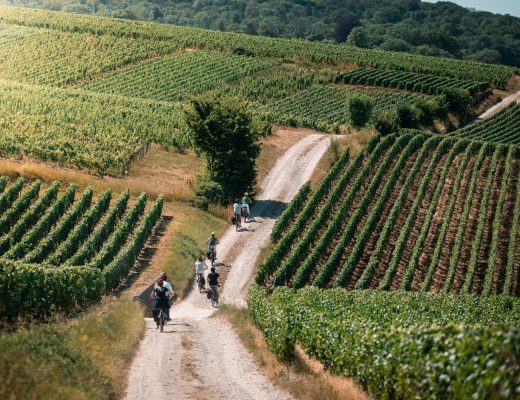
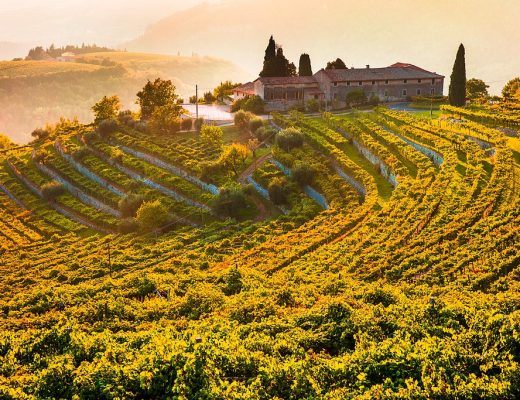
Unlike other spirits such as whisky or brandy, Cognac is also a place and uses grapes as its starting point. The vast fields of grapes that herald one’s arrival in Cognac are like soldiers in a well-organized army, flanked by undulating roads and centuries old stone walls and buildings. Driving along the winding roads, Cognac’s vineyards stretch as far as the eye can see. Unbroken distances of vines stretch to the horizon – more on this later as there is a practical reason for this voluminous grape growing.
Read Also: Sherry explained: A fortified wine experiencing a global renaissance
There is also something unusual about the homes and masonry that fill Cognac. You cannot miss the dark stained roofs and walls dotted around every corner. This is no accident of the weather. It is part of the Cognac way of life. The elixir that ages in barrels also evaporates and as the vapor disperses in air (called the angels share) the ubiquitous fungus, called Baudoinia compniacensis, uses the carbon in the ethanol vapor as a food source once it settles on surfaces. Locally it is known as Torula and although it is black in colour, it does not harm the structures on which it grows. In days gone by this would indicate Cognac was being aged on premises – which would alert the tax collector that money was to be paid.
Cognac regions and grapes
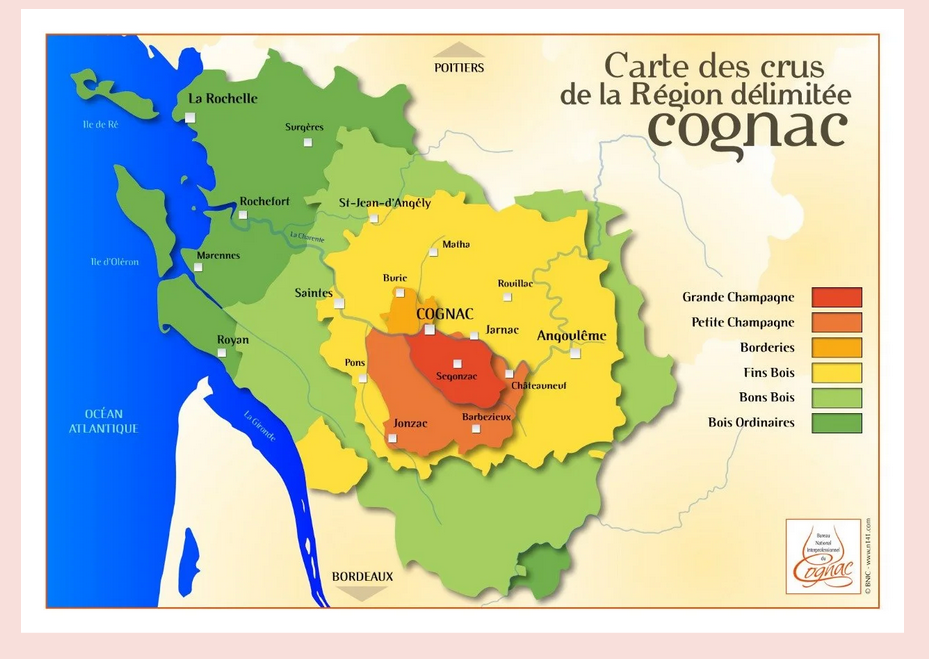
There are six growing regions and three primary grapes in Cognac. The largest cru in terms of hectares of vineyards is Fins Bois. The smallest cru is Borderies. This is not the same as the total area; it is the portion of land dedicated to vines. But the vines that produce the finest of spirits are in the regions known as Grande Champagne (about 13,000-14,000 hectares) and Petite Champagne (15,000 – 16,000 hectares) – not to be confused with the famous Champagne region in the north of France.
Petite Champagne produces a slightly lighter Cognac than Grande Champagne, but they are both highly prized because the Cognac made in these areas is refined and ageworthy. Grande Champagne Cognacs can be aged for 20 plus years and those from Petite are typically aged 15-20 years. Cognac from Borderies tends to be quite complex and aromatic while the less complex from Bons Bois offers approachability for younger Cognacs aged from 5-10 years.
Within Cognac there are three predominant grape varieties used in the making of its namesake. Ugni Blanc makes up over 95 percent of Cognac grapes and is prized for its fresh acidity. Folle Blanche is somewhat floral in character and is more delicate. Colombard is fruity and aromatic and is only used in small amounts. Ugni Blanc is dominant in both Grande and Petite Champagne, and it is no surprise that it lends itself extremely well to distillation – which is the Cognac production method. It has properties that make it ideal for growing with minimal intervention and the making of Cognac. It is disease resistant and has a lot of natural acidity rendering it able to keep Cognac fresh and stable. Its low sugar content means it provides a lower potential alcohol which is important in the required double distillation process for Cognac when flavours are concentrated.
Cognac production

The Bertrand family has been involved in Cognac since the 1730s.
In the 18th Century the traditional method of Cognac production was extremely manual using wood or coal to fire copper pot stills. Experience and patience were rewarded with a taste and smell only the fully initiated could determine. Smaller stills were not standardized, and the product was less consistent. This artisanal approach produced eaux-de-vie (the base spirit of Cognac) from double distillation that needed to age for extended periods to soften and had a more rustic feel.
Fast forward to current methods and wood and coal have been replaced with gas or steam heating. Precision monitoring of temperature, flow rates and alcohol strength give the distiller a way to more accurately decide which cuts make the final product. Each batch is slowly heated and takes 8–12 hours per distillation. In a modern production run, Cognac distillation is essentially watched continuously, but not usually by one person for 24 hours straight. This may not have been the case in early production days when the small, family-owned Cognac houses had one master distiller.
The first distillation is called the Première chauffe and it produces brouillis. The second distillation, called the Bonne chauffe, produces the final eaux-de-vie. Alcohol content is legally limited to approximately 72 percent ABV and today’s eaux-de-vie that goes into the oak aging barrels is much more consistent.
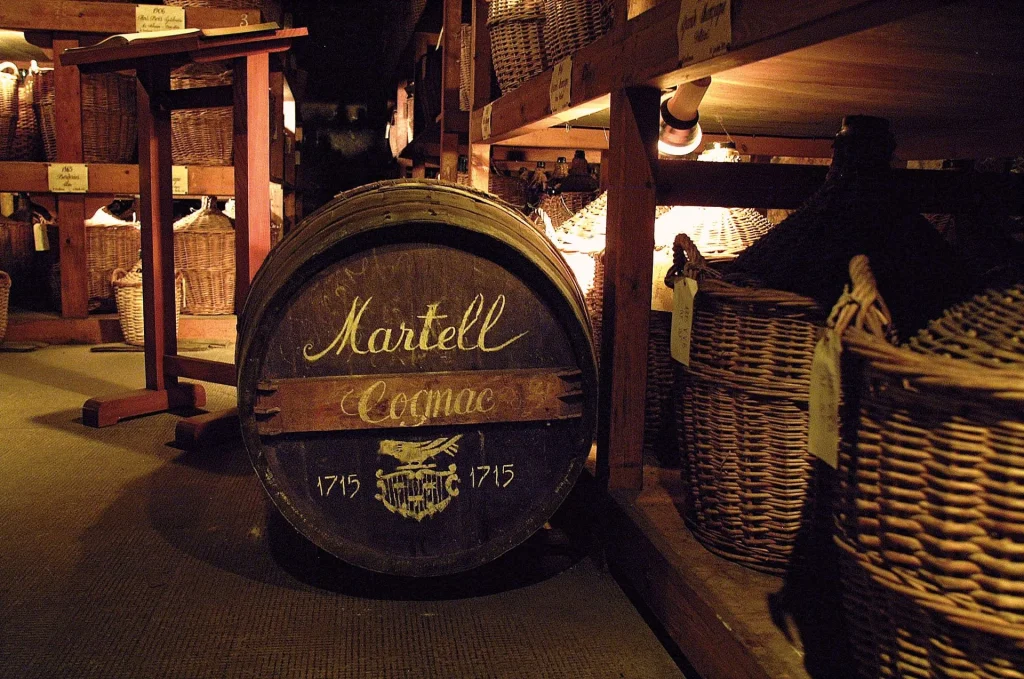
Martell was founded in 1715.
So, back to why there are so many hectares of grapes. Yields undergo double distillation which reduces volume as it concentrates – and there is a legal alcohol limit. Using 5 kg of grapes yields just over one half of a standard 750 ml bottle of Cognac at 40 percent ABV. Not so for wine which produces around five standard 750 ml bottles from 5 kg of grapes. That 10:1 ratio of wine to Cognac volume means the weight of grapes that must be grown to produce Cognac is therefore much larger than that needed to produce wine.
Not all spirits are equal. Why are whisky yields so much higher than Cognac? Whisky begins with a grain starch, not grapes. That starch provides a highly convenient conversion to sugar and thus the starting alcohol is higher, plus there is a smaller distillation time because whisky undergoes a single distillation – all of which means there is more whisky spirit per kilogram of input. In real terms then, 5 kg of grapes produces about 0.4 liters of eaux-de-vie for ageing in Cognac production whereas 5kg of grain yields around 0.7 liters of final spirit for whisky.
Size matters
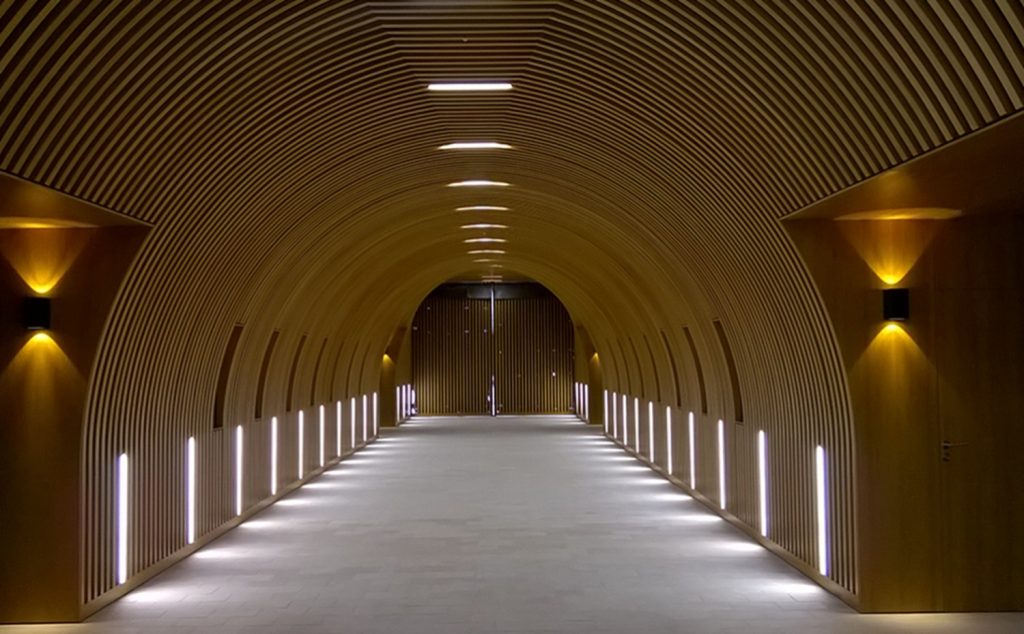
Martell.
Because it takes a lot of land to generate grape yields that can sustain a Cognac business, there are a few very large commercial companies that dominate the landscape. They have grown with time and have acquired land from smaller operations that no longer wished to stay in the marketplace. The difference in operation and style is significant. By way of contrast the Bertrand family’s involvement in Cognac originated in the 1730s and Martell, which is an internationally renowned brand, was founded by Jean Martell in 1715. That’s where the similarity ends.
The Bertrand family established themselves in the Petite Champagne cru as millers and wine growers. In the fullness of time, they began to distill their Charentais wine into eaux-de-vie. As the family grew so did the connection between the generations. Their land became the foundation of an estate business both locally and further afield. By the late 1940s when Raymond Bertrand married Simone Vallet (who was also from a winegrower-distiller family) their estate grew in significance. Simone continued to guide the estate after Raymond’s passing and as of today the family legacy continues with Therese Bertrand and her brother Samuel. This is a three-century legacy of vineyards, distillation, cellar aging and expertise. Their property, including the distillation copper pots stills and aging cellars, is human scale. They escort visitors through the production and aging process which is akin to a visit to their family home. Therese is on hand to answer questions and is present in every aspect of the business.
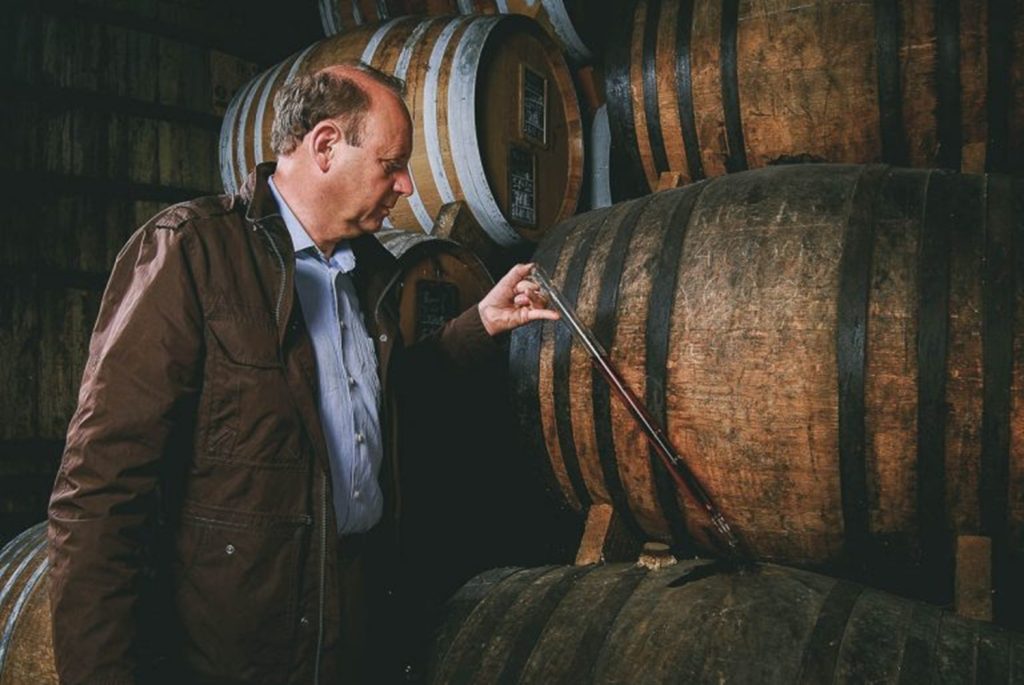
Bertrand.
By contrast, a visit to Martell is a grand scale operation with a visitor center that is a massive commercial enterprise. Jean Martell wanted an export business, so he set his sights on England and Northern Europe. In short order his international spirit empire took off and the trade networks in place at the time enabled rapid growth of a luxury brand known for reliability. Martell focused on the Borderies cru which provided a Cognac with a smooth and floral character. To keep up with demand, Martell routinely purchases grapes from other growers in Cognac. Successive cellar masters refined and styled their Cognac after their own tastes making them reproduceable thereafter. The business became so successful that it was purchased by Seagram in 1987 and was no longer family held. Subsequently, the Pernod Ricard group acquired Martell as part of their Seagram spirits portfolio purchase in 2001. The visitor experience is a study in history and business acumen. The property is magnificent and an encounter with yesteryear romanticism coupled with a modern-day look at large-scale production and marketing.
Tasting notes
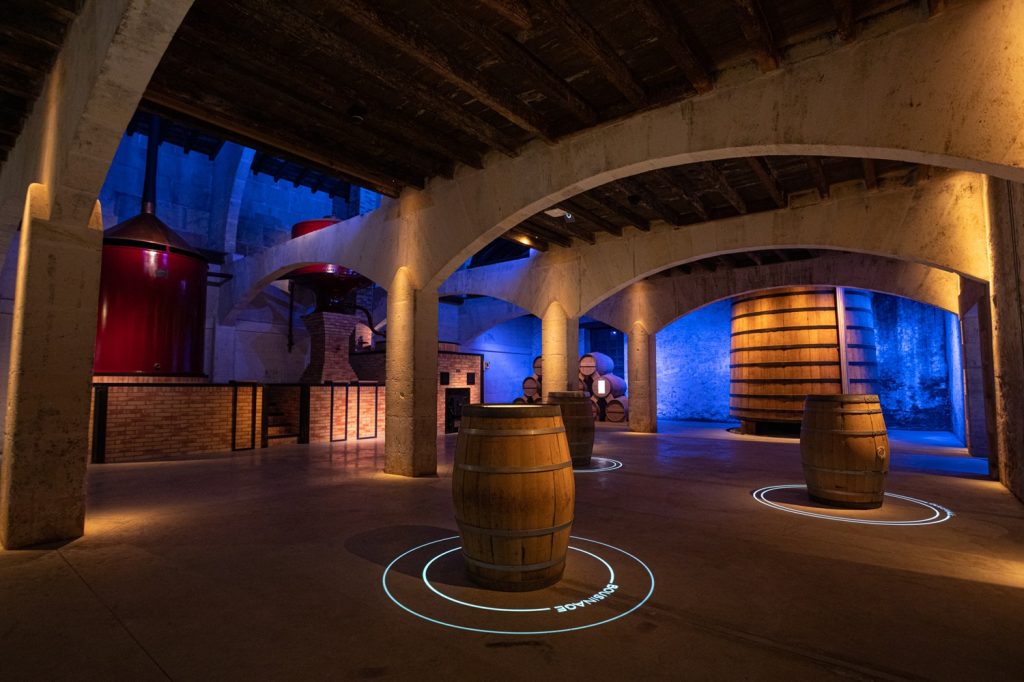
Martell is a grand scale operation with a visitor center that is a massive commercial enterprise.
D’Usse VSOP 375 ml
This is a small format bottle for those wanting a smooth and younger Cognac. This is balanced and is mildly nutty with notes of cinnamon, wood, and citrus. Primarily Ugni Blanc grapes mostly from the Fin Bois cru, but with other Cognac crus in the blend. ($48)
Hennessy VS x Nas 750 ml
With combined freshness and nuttiness from maturation in new oak barrels the blend must have components aged a minimum of 2 years but likely has some aged up to about 8 years. Made primarily from Ugni Blanc sourced from the Grande and Petite Champagne, Borderies and Fins Bois crus. ($83)
Martell Cordon Bleu Cognac 750 ml
This Cognac uses primarily Borderies grapes. It has developed floral, spice and woody notes alongside dried fruits and vanilla. The Borderies eaux-de-vie make it a warm finishing Cognac. The blend was created by Edouard Martell in 1912 as an Extra Old (XO) variety meaning it is aged in barrels for a minimum of 10 years. ($239)
Hardy Noces d’Or 750 ml
This Cognac is made with grapes grown exclusively in the Grande Champagne cru. This expert blend is made from eaux-de-vie aged for at least 50 years before bottling. It has overtones of lilac and violets with a candied cherry mid-palate. The flavors are well paired with chocolate and coffee. ($570)
Cognac Bertrand 750 ml
This is a smaller family business but their Cognac can be sourced through “Cognac Expert” – an online retailer. Prices range from $42 – $135CAD depending on the style and age of the Cognac.
– Gillian Marks, PhD. has been a contributing editor with VineRoutes since 2022