


As tariffs and retaliation collide, Canada’s spirits industry faces unexpected winners, quiet losers, and governments slow to act
Whether the world is indeed teetering on the precipice of a New Global Order remains to be seen. However, there can be no denying that a very real upheaval is starting to shake up the beverage alcohol world, both in Canada and abroad.
A convergence of less than toast-worthy circumstances is causing a degree of uncertainty as to where the industry is headed. Some of the reasons are socio-economic.
Depending on the country and age bracket of the consumer, booze consumption is declining. In some cases, health concerns are cited (the “any amount is bad” message hasn’t helped). There’s also that cost-of-living thing.
Read Also: VineRoutes’ Top Spirits of 2025: Shots across the bow
Other reasons are political. And last year was the year when booze became the retaliatory weapon of choice for Canadian politicians to fire back against President Trump’s tariffs.
Stripping store shelves of American liquor certainly has had an impact from an optical “take that America!” standpoint. It was also thought that the gap in the American section of people’s bars would be filled in with Canadian products.
A windfall for Canadian whisky… sort of
Numbers suggest that – at least when it comes to wine – this hope has, to an extent, borne itself out (particularly in licensees). The most dominant US beer brands – Budweiser and Coors – are both brewed under license in Canada (so technically not American-made). But what about spirits? Has the pulling of US-made whiskey (the most significant category of south of the border imports) actually had any negative impact on US-based distillers? Has the move led to renewed interest in local potables?
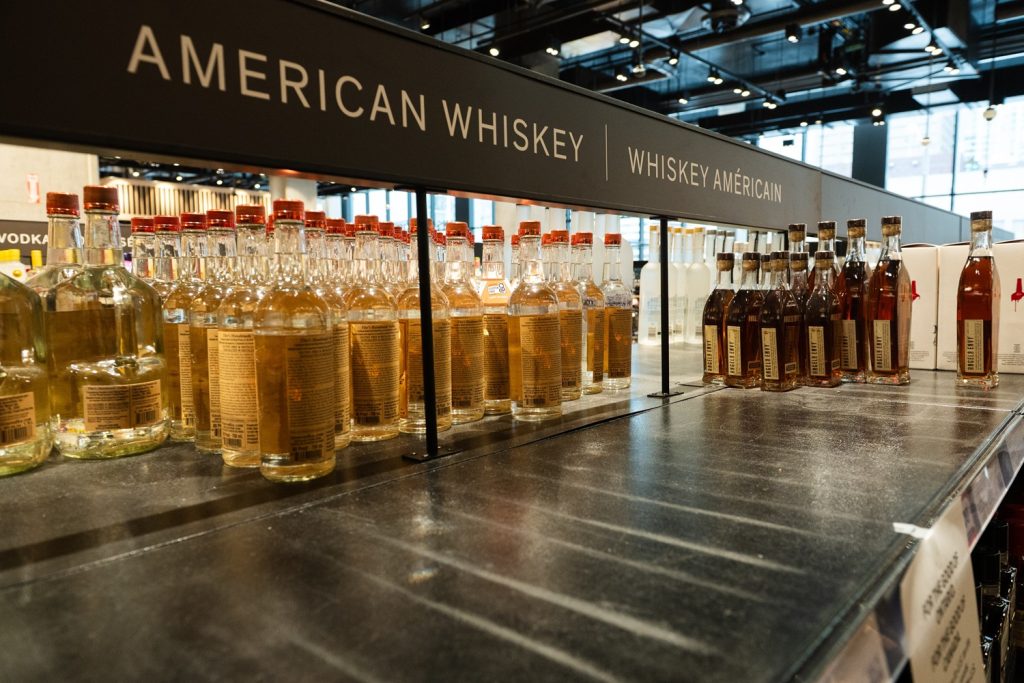
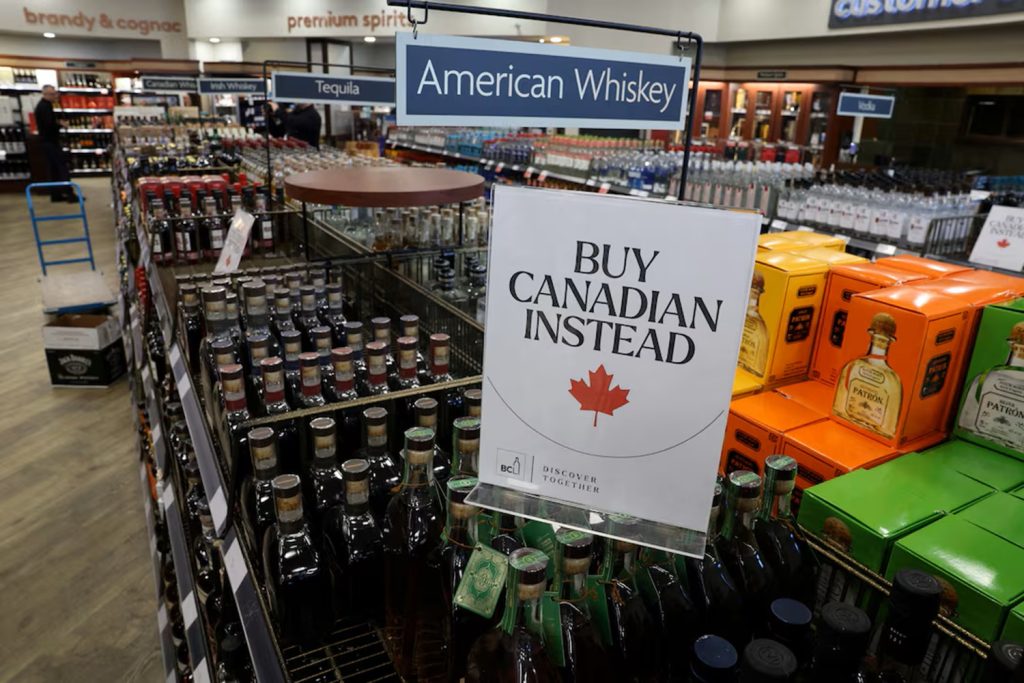
Shelves of US whisky were laid bare almost a year ago after the Trump tariffs took effect.
To the first part of the question, yes, US distillers have been hit pretty hard. Imports of US-manufactured spirits are obviously down sharply in Canada (a reported 62 percent decline). In fact, sales of US spirits in other major global markets are also on the decline. The US-based “Toasts Not Tariffs Coalition,” made up of 57 distilling organizations – including the Distilled Spirits Council of the United States (DISCUS) – sent a letter in late 2025 to President Trump urging him to drop the tariffs, which the organization claims are threatening to eliminate some 25,000 US-based jobs. In fact, Jim Beam Distillery has cut production this year due to a decline in demand, with the tariffs being cited as a significant reason for this.
Some Canadian distillers are also feeling the impact of the tariffs on their own production.
“I spoke with one distiller who was bringing some botanicals in from Europe,” recounts Alex Hamer, founder of the Canadian Artisan Spirit Competition (CASC). “But the only way to get them was through the US, which meant their supplies had tariffs applied twice. So much of distillers’ equipment and supplies comes from the US, and the small distilleries run on such tight margins that it’s difficult for them to absorb tariffs on even the smallest of supplies.”
When asked to comment on the second part of the question, Davin DeKergommeaux, Canadian whisky expert and author of Canadian Whisky, the Essential Portable Expert (now in its third edition), responded with:
“Based on interviews with brand managers, brand ambassadors, distillers and independent retailers in Alberta and BC there has been a sharp, sustained boost in sales of Canadian whisky and possibly other Canadian-made spirits. For example, increased sales of Canadian Club and Alberta Premium have helped offset losses from American Beam products [both Canadian brands fall under the Suntory Global Spirits umbrella, which also represents a number of US whiskey brands, including Jim Beam], while sales of Reifel Rye have more than doubled.
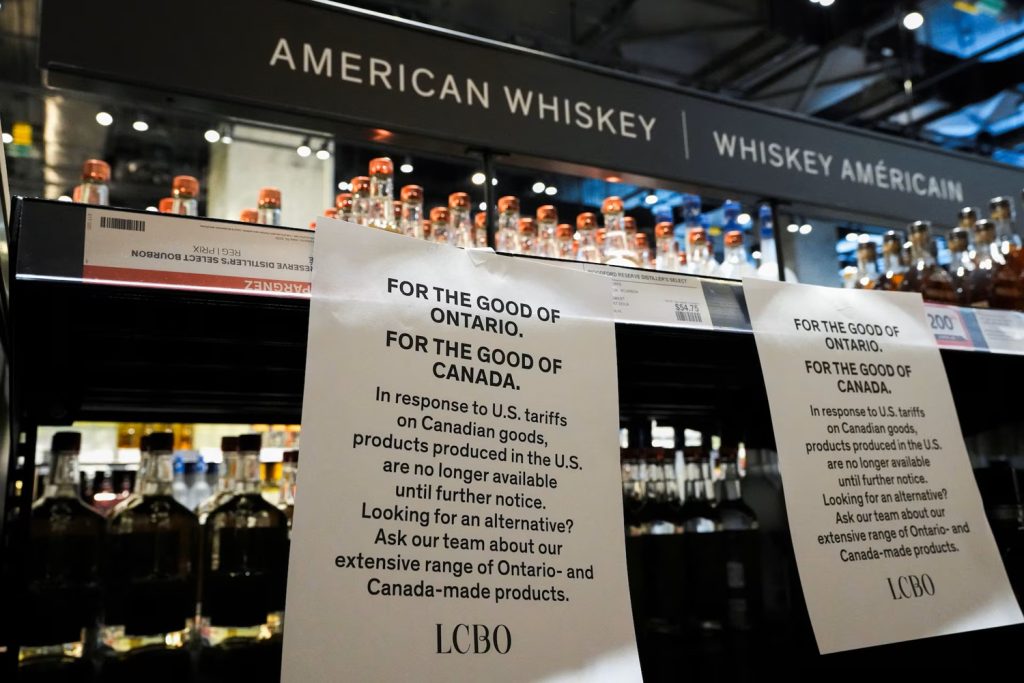
Letters taped to shelves in most liquor stores across Canada urged consumers to buy Canada-made products.
“John Sleeman and Sons have seen sales of their Spring Mill Straight Whisky jump to the point where they can no longer keep up with demand. In the field, demand for Forty Creek is noticeably up. According to their quarterly sales report Corby has seen a 15 percent increase in sales of Canadian-made spirits of all types, so this likely includes Malibu rum and Absolut vodka.
“Okanagan Spirits, which produce bourbon-like whiskies reports a doubling of sales. I’d say, they [Okanagan Spirits] are the poster child for turning this into an opportunity. Meanwhile, the Strath liquor store in Victoria BC that is visited by quite a few American tourists, tells me they, too, have really hopped on the buy Canadian trend.”
DeKergommeaux also points to the atmosphere at a recent whisky event.
“For the small distillers, and this was visible in an almost euphoric tone at the Canadian Whisky Awards this year, it [the removal of American spirits from the market] has been a godsend. The downturn that whisky makers in most other countries are experiencing has been dampened considerably for Canadian craft distillers. For the larger multinational brands, there have been some layoffs of staff responsible for sales of their American brands. Those major distilleries I asked would like to see the boycott end.”
Governments miss the moment
With the lack of US-made spirits in the market, and the overall push to “buy Canadian,” you’d think that the time would be right for Canadian governments at all levels to lead a collective push to lend greater support to all facets of the Canadian distilling industry either through financial incentives or marketing efforts (or, ideally, both). Yet this doesn’t appear to be happening.

Alex Hamer is the founder of the Canadian Artisan Spirit Competition (CASC).
While the newly proposed Alberta Whisky Act might go a long way in assisting distillers who make the stuff, there doesn’t, on the surface, appear that much else is happening. In a letter obtained by the CBC via a Freedom of Information request, Premier Ford stated: “LCBO is working with Ontario and Canadian-based producers to ensure our customers enjoy a selection of made-in-Ontario and made-in-Canada options [to US-made spirits].” However, nobody in the industry who I spoke with saw any signs of increased support in Ontario or elsewhere.
“Unfortunately, I haven’t seen action,” admits Hamer.
“Help for artisan distillers at both the provincial with manufacturing or retail help, and federal level, with excise breaks, are sometimes talked about, but change is slow or never appears. A great example of this is the recent deal to eliminate trade barriers between provinces. One glaring exclusion was alcohol sales – apparently ‘to be worked on later ….’ The provincial liquor retailers want to protect their monopolies at all costs.”
Hamer observes that, “In British Columbia, the province spent months with empty shelves, which used to be full of US spirits, taped off with signs telling consumers to ‘Buy Canadian.’ But there are almost no craft spirits on the shelves due to the punishingly high markups, which are unrealistic for small producers. BC Liquor then resisted a strong effort by our craft distillers to give them the same discount deal our provincial VQA wine producers get, in this case a 50 percent discount on the retail markup, which would have allowed distillers to sell in BC stores and actually make some profit.”
The reduction of the excise levied on Canadian spirits is seen by many in the industry as probably the most significant move to assist the industry. Hamer feels this is “…the biggest lever the federal government could pull.”
“The US provides significant tax relief for the first 100,000 proof gallons of spirit produced, while Canada only ever increases rates,” Hamer claims. “Very roughly, in Canadian dollars, for a 750ml bottle of spirits at 40 percent ABV (alcohol by volume), an American distiller would pay about $0.60, and a Canadian would pay $4.15. This break is applied regardless of the overall production, giving small distillers a valuable leg up, but also giving larger distillers the same break on some of their production.”

James Grant, Beverage Director at Fairmont Royal York in Toronto.
Hamer adds that for artisan or craft distillers, there’s a good argument to be made for provinces to provide additional assistance. “I’ve already mentioned the VQA wine-style discount BC could apply to craft distilleries in this province – which, by the way, are under much greater restrictions than wineries. There are similar options available in many other provinces.”
Putting all this in a nutshell: are US distillers being negatively impacted by Trump’s tariffs? Yes. Are Canadian distillers benefiting from retaliatory moves by provinces? Yes. To a degree. Are Canadian governments using this opportunity to convince consumers to “Buy Canadian” and to offer some much-needed breaks to distillers? Not that anyone can seem to see.
The average Canadian whisky drinker is likely pretty indifferent to the lack of US spirit availability. There are after all plenty of alternatives (Canadian or otherwise). Can the same be said for licensees, especially the ones that host a substantial US-based contingent who might be looking for a taste of home while in Canada?
I spoke with James Grant, Director of Beverage at Fairmont Royal York to ask about the impact of a scarcity of American spirits. The historic Toronto landmark hotel is home to Library Bar, Clockwork Champagne & Cocktails, and the VineRoutes Vine Award-winning REIGN restaurant.
“We’ve certainly seen an increased interest in the Canadian whisky category,” Grant reveals. “This has aligned very well with our goals of showcasing incredible home-grown Canadian ingredients to our international guests. While there may be some local pride driving the sales of Canadian spirits, we also built our current beverage program in the context of US spirits being inaccessible. So, that’s had a knock-on effect of increased sales in other categories, both Canadian and international.
“We have been really blessed in the last year with the opportunity to build cocktail menus that really celebrate the incredible spirits and liqueurs that are being produced in our own backyard,” he continued. “Our food and beverage programming has always been locally-focused, and this year has seen our clientele enthusiastically join us in championing our local producers.”
The Ford–Crown Royal paradox
That the various government’s reaction to the tariffs is economically impacting the parties it’s intended to seems to be mostly affirmative. However, sometimes (yes, you could argue “often”) political reaction to situations can go a bit off the rails. To wit: The Ford Crown Royal Affair.
To set the stage, Crown Royal is an iconic Canadian whisky brand that is actually the top-selling whisky in the US…of any whisky produced anywhere. It’s distilled in Gimli, Manitoba, and bottled in both Valleyfield, Quebec, and Amherstburg, Ontario. That is, until recently.
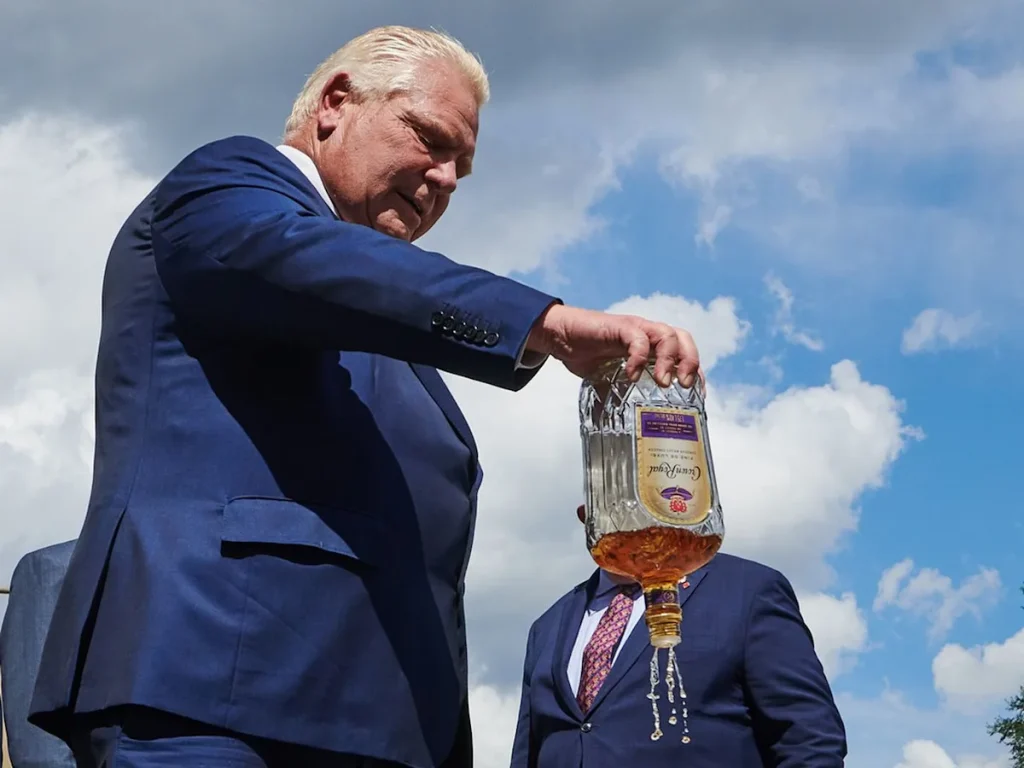
Ontario Premier Doug Ford unceremoniously pours out a bottle of Crown Royal during a media conference. (Canadian Press)
The Crown Royal brand is owned by Diageo, a British multinational conglomerate. Its decision to close its Amherstburg facility (made long before the whole Canada/US booze battle started), with the subsequent loss of 160 jobs, got Premier Ford pretty riled up. Not only did he publicly dump a large bottle of the whisky for the tv cameras (which, thanks to the bottle’s spill guard stopper took the better part of forever to accomplish), he also claimed he “couldn’t wait” to pull all Crown Royal blends from Ontario liquor store shelves. He also invited anyone who’d listen to “mark [his] words” that Diageo would eventually move Crown Royal production to the US.
None of this makes any sense. At all.
First, pulling Crown Royal from the Ontario market would likely affect, to some degree, production volumes, which in turn would have an impact on jobs at the Gimli plant. So, more job losses at Crown Royal Canadian facilities. Which is exactly what Ford is up in arms about. Second, if Crown Royal production is moved to the US, it would technically be an American spirit and therefore not be for sale in Canada (under the current US booze ban). The loss of the Canadian market would not be in Diageo’s better interest…nor Gimli’s (Crown Royal apparently accounts for around $740M in business in Ontario alone). More job losses likely in both the US and Canada.
There are probably more negative implications for both Canada and Diageo should either of the above scenarios transpire. Yet, Ford is still threatening to pull Crown Royal from Ontario shelves if Diageo doesn’t present a plan to replace the 160 lost Amherstburg jobs. But since when do private multinational corporations have an obligation to protect Canadian workers?
Maybe I’m being too harsh, but corporations tend to act in their own self-interest. Diageo is shifting its bottling of Crown Royal destined for US sales to the US to maximize supply chain efficiency. Whisky bound for sale in Canada and international markets will continue to be bottled in Quebec.
In any case, as I’ve said before, 2025 was the year booze was weaponized in Canada. 2026 will no doubt be the year we see whether the current US booze strategy in Canada hits the mark or backfires in our face.
– Tod Stewart is senior editor of VineRoutes